Reflections and stories on six months of life, culture, food and friendship in Hanoi, Vietnam.

Friday, March 10, 2006

Both Sides Now

A few days before my departure I was invited to a house party hosted by two Americans. The party was split down the middle, expat and Vietnamese, so it seemed an appropriate anticipation of my transition back to the West.

I've written a lot about the way Vietnamese socialize in groups. The differences with Western modes of socializing were in stark contrast at this party. Predictably all the expats gravitated towards the kitchen. The Vietnamese meanwhile camped out in the living room. But the way they were relating was the most interesting thing.

I didn't know any of the expats, but all I had to do was stand around a few minutes in the kitchen before a few people introduced themselves. Although these introductions were generally stiff and awkward ("Hi, my name is Barbara. How long have you been in Hanoi?"), I was still struck by the peculiarity of this sort of cocktail conversation in which strangers introduce themselves and search for intersecting interests. There should be nothing unusual about this except that I could see it fresh after being away from it all for so long. Here was a room full of mostly unrelated individuals chatting in small clusters, mixing and regrouping throughout the evening. All the sudden I could see the fluidity of the Western kind of socializing. There was a kind of randomness and serendipity, like atoms bouncing off each other.

In the living room there was no mixing and mingling whatsoever. Instead the Vietnamese group all knew each other and hung together like a big family. They were essentially draped over each other on the couch and the floor. If you didn't know them already there would be little way to break in. But in contrast to the random fluidity in the kitchen was warmth and casual intimacy. Once I'd had my fill of finger food I opted for the living room where I curled up the couch with the rest of them.

Now I am back in Toronto and this contrast is even starker. In Hanoi I would sometimes complain about the cliquey-ness (sp?) and the fact that people wouldn't talk to others outside their group. Now I can see the good and the bad of each pattern. We Westerners may be better at introductions, and mixing and mingling, our social networks may be more open and less defined, but intimacy between friends doesn't seem to come as easy for us.

I don't know if the patterns I saw were specific to the gay community, or reflective of wider society. I also don't know if they are specific to Vietnam or other Asian culture, but when I shared my observations with a Singaporian friend here, he recognized it all immediately. When he moved to Canada two years ago, he felt isolated. Sure you can meet people, but social plans have to be arranged a week in advance. You do not have to break your way into a clique and to this extent it might seem less complicated, but people only have so much time for you because they are busy balancing their other social commitments.

Despite the closed nature of the groups I experienced in Hanoi, they afforded a family-like intimacy. No need to make plans days in advance because it was taken for granted that the group would hang out. One phone call and half an hour later the group might be meeting for coffee or bia hoi.

I may have a large social network here, but my mobile phone rings only occasionally. I miss that intense interconnectedness, and the way I was always receiving new text messages. I miss the spontaneity and the feeling of being embraced by a close-knit family of friends.

Travel may be a outward exploration but it is also about the discovery of self. It's about the return as well as the voyage. There are moments when you suddenly discover the peculiarity of who you are and where you come from, and this party off Nguyen Thai Hoc was one of those moments.

In the end I succeeded in breaking down some of the barriers between two groups in Hanoi. (I will have to save that for another post.) Now the challenge is to bring more of that warmth and spontaneity into my Canadian social world.

Labels: , , , , ,

Thursday, February 09, 2006

Never The Twain

One thing that half a year in a country will do is to strip away some of the layers of fantasy and orientalism that are unconscious to many of us in the West. During my first encounter with this country three years ago as a tourist I vacillated between thinking I could understood the place and a feeling of profound incomprehension. Both reactions are off the mark but inevitable. Over time the experience of the exotic has been replaced by an understanding of the Vietnamese world as lived, and gradually I can begin to see how the horizons of East and West overlap and on occasion even fuse.

Of course six months is not a long time all things considered, and there are still many cultural differences that truly baffle me. These are phenomenon whose inner logic escapes me. Now that my days here are seriously numbered all can do is describe some of them and surrender for now my attempts at true understanding.

No Thank You
The constant need to say thank you is deeply ingrained in the Western brain (maybe especially in Canadian ones). There are casual thank yous and then there are heartfelt ones. I completely understand how absurd the casual thank you can appear to the Vietnamese. When we are at a restaurant we say thank you when the waiter brings the bill. But why would we do this? This is all part of the waiter's expected role, not some kind of personal mitzvah. Besides, why would you thank someone for asking for money? Ditto with the kind but wimpy way Westerners tend to deal with hawkers pestering them on the street. I've heard tourists proudly use the literal Vietnamese translation of "No, thank you". Thanks for what? Seeing me as a source of income? There is no rational reason to thank people for merely fulfilling roles.

All Action, No Talk
Then there is the heartfelt thank you. I have been on the receiving end of so many generous acts here and I truly want to express a deep sense of gratitude. "Thank you" is fine in this context, but all that's needed is a quick understated "thanks". I have trouble with this because I sometimes experience a surplus of unexpressed gratitude, but if you go too far it's seen as overly formal and even possibly insincere. On one occasion I was even told that my thanks were unnecessary, and that true thanks are expressed by doing something in return - ie. words can be cheap. The opposite could be true for the Western sensibility with this expectation cynically interpreted as some kind of debt that is due - I scratch your back, you scratch mine. So which is more "authentic", saying or doing? And this leads to my next theme.

Direct/Indirect
People here can be very direct with some things. I have been told point blank that I have bad skin, I am too hairy, I am lazy and of course I speak atrocious Vietnamese. If you are fat you will probably be told that to your face on a daily basis. And on a linguistic level the imperative is far more acceptable here than our Western way of couching requests in indirect niceties; the Vietnamese tell you what to do, while we preface requests with things like "would you mind?" or "can you please?"

Other things though are never to be expressed outright. Direct Western style expression is apparently seen as crude and confrontational as compared to the subtle approach used here. If you have a beef with someone, don't tell them - suggest it in a roundabout way to a mutual friend, ask them not to say anything, and watch as it make it's way back anyway. I have had several issues brought to my attention this way. I was once mystified by something that happened with a friend. I tried to ask directly for an explanation, but hit a stone wall. The harder I tried, the less I got. I understood much more later when things came out in a more by-the-way and less forced fashion. Sometimes though this kind of subtlety is completely lost on us foreigners. When a Western colleague began his contract he was fed apparently free lunches for several weeks before he suggested that they should really be asking staff to pay at least something. "We are so glad you finally asked," came the response, "Everyone's talking about your freeloading" ...or words to that effect.

Closed Social Networks
I am going away soon and I was contemplating a farewell house party. What could be more normal than inviting all my friends over for a big bash? In fact it would be like watching a train wreck in slow motion. You can know several "groups", but you shouldn't try mixing them. I have tried. Social networks are closed systems, at least in the gay world. The Vietnamese I know are generally lousy at introductions. You can be talking to a friend, someone else will appear but no word on their name or identity. The introductions I have attempted have fallen flat. All the groups I know hang out at the same places and know each other at least by sight, but there is little talk between groups. People go to clubs to hang out with their groups, rarely to actually meet anyone new (In fact I've almost never seen this happen in my group). I have asked friends why they don't talk to people in other groups (especially since the gay world here is so damn small), and I have consistently been told that they have nothing to say to each other and that conversations would be awkward and boring. Somehow talk is group-specific.

What baffles me even more is how groups form to begin with given these rigid social structures. One thing is certain though, people are only truly admitted to a group if they fit a certain profile and they improve the collective image. Outside the public realm though individuals associate much more freely. If you dig a bit you will find that are wider personal networks that belie the public patterns of group interaction. This tension between personal and group relations that makes for fascinating intrigue. There are people I'm friends with on a one-to-one basis, but who are actually quite distant in public spaces. I now know not to be offended by this.

I don't intend any of this to sound judgmental. These are just some of the things I don't understand. The longer I am here the more complex things become. Sometimes trying to figure it out can be like looking at a night sky in which faint stars recede when you try to stare them down, but reappear when you take in the whole panorama. Certain cultural phenomena appear odd or even absurd in isolation but are strangely intelligible within a larger context. But six months doesn't get me there (does a lifetime?) and still so much escapes me?

Labels: , , , ,

Saturday, October 22, 2005

Notes on the Middle Kingdom

I just saw Jon off in a cab to the Beijing airport for his flight back to Toronto. I will hop in my cab in two hours to return to lovely Ha Noi. I've taken a two week hiatus from my blog to spend time with Jon and focus on China. It was very difficult to say goodbye again. It will be four months until our next reunion in Ha Noi, Laos and Bangkok. In any case, we had a great visit together. Now I've got to try to capture some of the experience in writing as well.

It's a strange experience coming to China from Viet Nam. I couldn't help but always be comparing the two countries. I think some of the things that Western travellers experience as foreign and "typically Asian" (like the two-wheeled traffic) were not novelties for me. Instead the contrast with Viet Nam highlighted other things.

Two weeks ago I arrived in Beijing and wandered around until Jon arrived a day later. I was struck by how modern and First World the city appeared. I got to see more of the suburbs than I wanted that first day because the cab driver took me to two wrong hotels before I realized he was cheating me and I fired him. Frankly, the suburbs looked like a larger version of North York. Some of the more charming areas downtown near my hotel could have been mistaken for shopping streets in some North American cities, if it weren't for the Chinese signs and the bicycles. On the surface it seemed so familiar - and yet, I felt so helpless. I will never again take for granted the use of the Roman alphabet in Vietnamese (quoc ngu). The lack of shared writing system in China complicates communication enormously. We had to walk out of many restaurants without English menus; food glossaries in phrasebooks are of little use in China. In addition, there is surprisingly little English spoken even in the capital. You can get by much easier in Viet Nam with English. Viet Nam is a country of 80 million and the future of the country lies to a great extent in its ability to forge connections with the rest of the world. With one billion people, China is not so much a country as a universe and so the need to engage with the "outside world" must seem less pressing. If anything the onus is on the rest of us to learn Chinese, and you certainly feel this reversal in this mammoth nation.

In any case, in China I experienced a paradoxical feeling of First World foreignness. Viet Nam appears much more exotic than China. There is not one street in Ha Noi that could ever been mistaken for a Western city. The plastic stool restaurants, the yoked vendors with their conical hats, the sea of motos all prevent that. However, there is a sort of impenetrability in China despite the familiarity of its modern face.

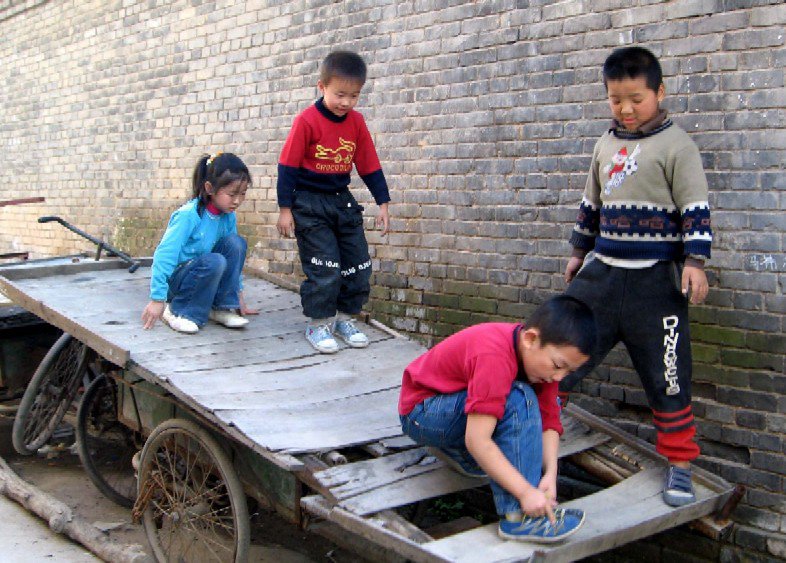
And then there is the scale of things. I don't just mean it's obviously large population and land mass. I mean the massive boulevards and highways, historical monuments, towering modern buildings, sea of pavement that is Tiananmen, and the most absurdly large train station one could ever imagine (pulling up to Beijing West Station was like docking into the Death Star - but without the evil connotations). And then in dramatic contrast, there are the hutongs. These neighbourhoods are are like an alternate world. You could crisscross Beijing by either of these networks: the god-sized grid of boulevards and monuments or the intensely human-scaled world of the hutongs with their courtyards, gateways, tea houses, and street markets. There is such a disconnect between these two scales. Sadly the hutongs are quickly being ripped up for modern mega-projects in preparation for the Olympics. Apparently there is a Chinese expression: "If the old doesn't go, the new won't come." I guess that was the excuse of the Cultural Revolution as well. Again this is in contrast to Viet Nam, which as far as I can tell does not share this view of history. Hanoi feels as if it developed by accretion over the ages, not through a series of grand statements and violent obliterations.

Enough of my musings. Here are some of the highlights.

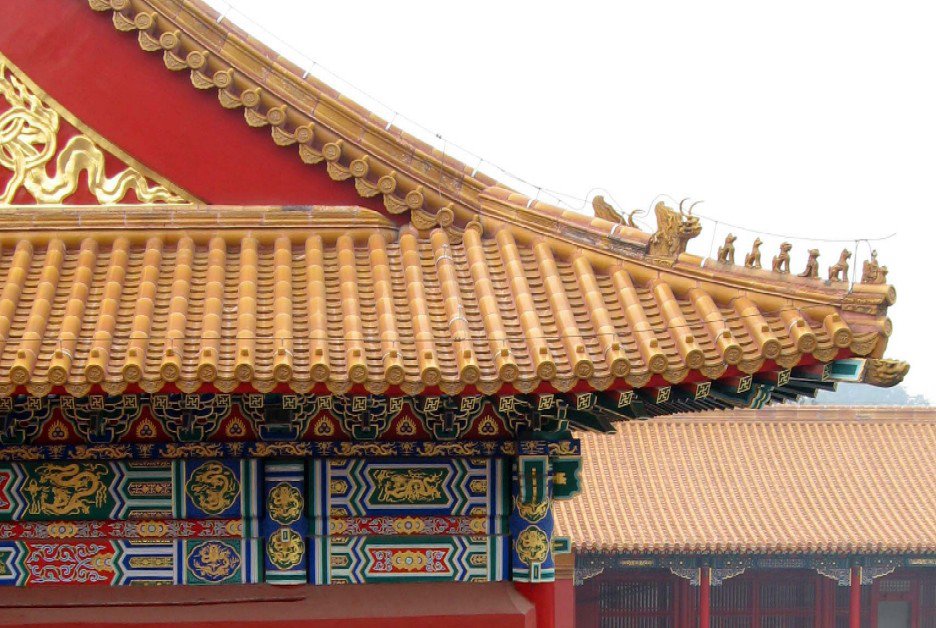
Beijing: First day at the incredible Forbidden City. It takes a full day and even then there were sections we didn't get to. Unfortunately the haze was bad for pictures. How did this survive the Cultural Revolution intact? The grand ceremonial plazas and imperial gates were spectacular, but my favourite part was actually the maze of little courtyards and gardens at the back where the court lived and worked. The haze on the second day at the Temple of Heaven was even worse and obscured the buildings, but lent a kind of mystery to the gardens surrounding it. We walked back from the Temple through Qianmen District with its little laneways and shopping alleys, around the Qianmen Gate and into Tiananmen Square. The Square affords some great views and is a must-see, but the vast featureless expanse (not to mention its history) felt oppressive to me. Stalinist architecture at its best! Great Peking Duck for dinner. The next day we intended to go to the Mutianyu section of the Great Wall, but were instead "Shanghaied" by our tour operator into visiting the Badaling section. It was still spectacular but I could have done without the cheeseball circus at the bottom (what does tossing tomatoes at black bears have to do with ancient China?). A day at the Summer Palace. The haze was gone, but unfortunately the main palace building was closed for renovation (damn the Olympics!). One of my favourite days in Beijing was our last day after our return from Shanghai. We rented bikes, rode to the Lama Temple (Tibetan holy site, ceremonial home of the Panchen Lama), back through the alleyways getting as disoriented as possible in the hutongs. We ended up at Jinshan Park and then followed the walls of the Forbidden City around to the entry gate in time for a military parade. We were lucky enough to stay in a historic hutong guesthouse which had once been the residence of an official in the Qing court.

Xi'an: Took the overnight train to Xi'an. We wondered if this was a mistake when we arrived at the intimidatingly huge Beijing West Station, but in fact the train was easy to figure out and well run. The main reason for visiting Xi'an is to see the Terracotta Warriors which are truly stupendous. It was also fascinating to be in a place which was once one of the great centers of the world: the first center of a unified China, and in a later era, the first (or last) stop on the Silk Road. The Silk Road influence can still be felt in the Muslim Quarter. I'm always a sucker for any old district with laneways, hole-in-the-wall noodle joints, and street vendors. We were lucky enough to visit the Great Mosque during a call to prayer and watched as the Hiu elders gathered in their white skull caps. Also an afternoon at the Large Goose Pagoda.

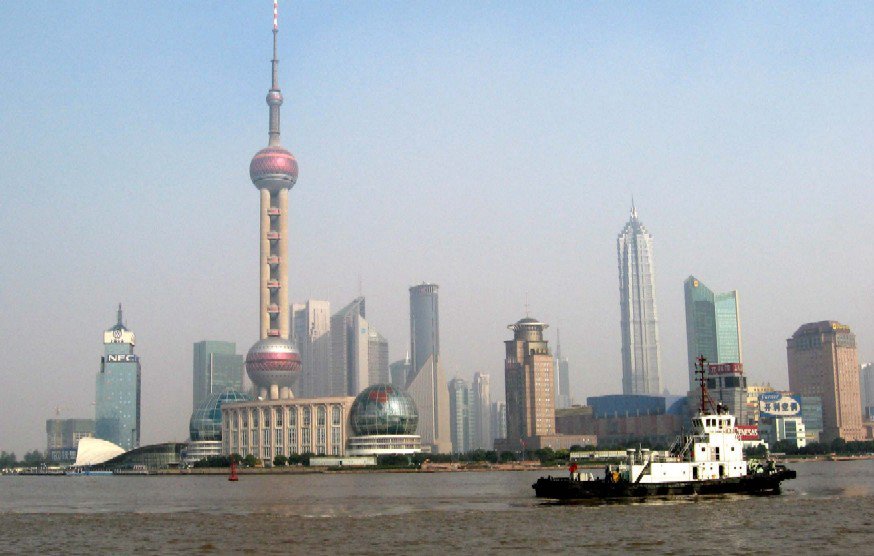
Shanghai: We overheard a lecture in our hotel in which millenial Shanghai was compared with its other great boom era in the 1920s and 30s. The time is now for this city which is in a constant state of metamorphosis. Shanghai felt like a (much!) larger version of Chicago. There are so many parallels: the Bund felt like Michigan Ave. facing as it does on a park and waterfront; both are showcases of architecture, from the vintage early 20th Century, City Beautiful and Art Deco to the experimental modern buildings; and both cities share a home-grown gangster mythology. We stayed at the top of the Bund in the largest hotel room in history in the beautiful Pujiang Hotel which dates from the 1840s and feels like the 1920s. The neon on Nanjing Ave. is spectacular at night if you can stand the "lady-bar" touts and "Rolex" sales creeps, but Huaihai Road is really where it's at. My favourite: our day in the Old Quarter, which felt paradoxically like entering a Chinatown. The Yuyuan Bazaar was a bit Disneyesque, but it didn't take long to get away from it all and get lost in the maze of old Shanghai alleyways, which were once a notorious nest of opium dens. We ate at a little fried beef noodle shop. Our noodles were about 2 minutes from dough to bowl. We also wandered around a flower market, a insect and (pet) bird market (yeah, yeah, I know...the bird flu!) and through the French Concession. Another day we made it up the Jinmao Tower in Pudong.

Well, there is so much more, but I'm sure I'm testing the patience of even my more faithful readers. Also, I am no longer in Beijing. I am now in the little internet cafe behind my house on Vo Thi Sau. There is nothing like returning to make a place feel like home.

Labels: , , , ,