Yao Paintings Redux
Sometimes it's all about the comments not the entry. This was definitely the case with my March 22nd piece entitled The Mystery of the Painted Scrolls. The entry was an experiment to see if I could harness the collective knowledge of my virtual readership to help identify and interpret two painted scrolls I purchased on the eve of my departure from Hanoi. I was not disappointed. A special thanks to Anonymous and Wulingren for helping me understand the origin and meaning of these paintings. Because the discussion happened entirely in the comments section, and I know many readers skip comments (especially when there are 22!), I thought I would give an update - though I recognize this stuff is probably too esoteric for most of my blog readers out there.
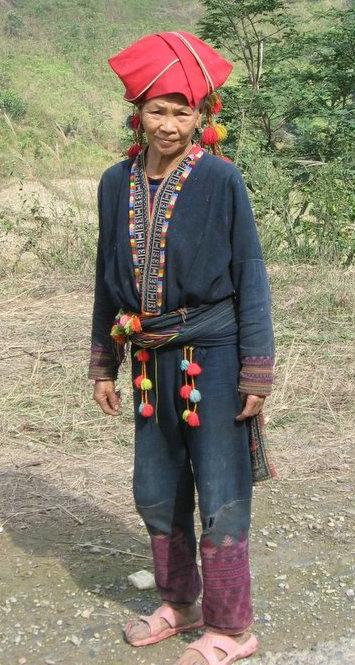 As it turns out I should not have been so dismissive of the vendor who told me the scrolls were from the Dao (aka. Yao) people in the Northern highlands of Vietnam. The Yao migrated into Southeast Asia (where they are scattered across the highlands of Yunnan, Vietnam, Laos, and Thailand) after being squeezed off their land near Shanghai in the 12th Century. (I've included a photo I took of a Red Dao woman in the countryside near Than Uyen, Lai Chau Province - see my entry Heaven's Gate.) They took with them a form of Taoism which became more distinct over the years. One of the central features of Yao Taoism are sets of sacred painted scrolls displaying the deities in the Yao pantheon. These scrolls are not merely depictions of these gods - in fact, the paintings are considered to be the abode of the gods who are present within them. The paintings are used for ceremonial purposes (such as ordination). When the paintings are old and worn out, the deities are invited to leave the scrolls in a "closing of the eyes" ceremony, after which they can be sold. It seems I bought some cast-offs.
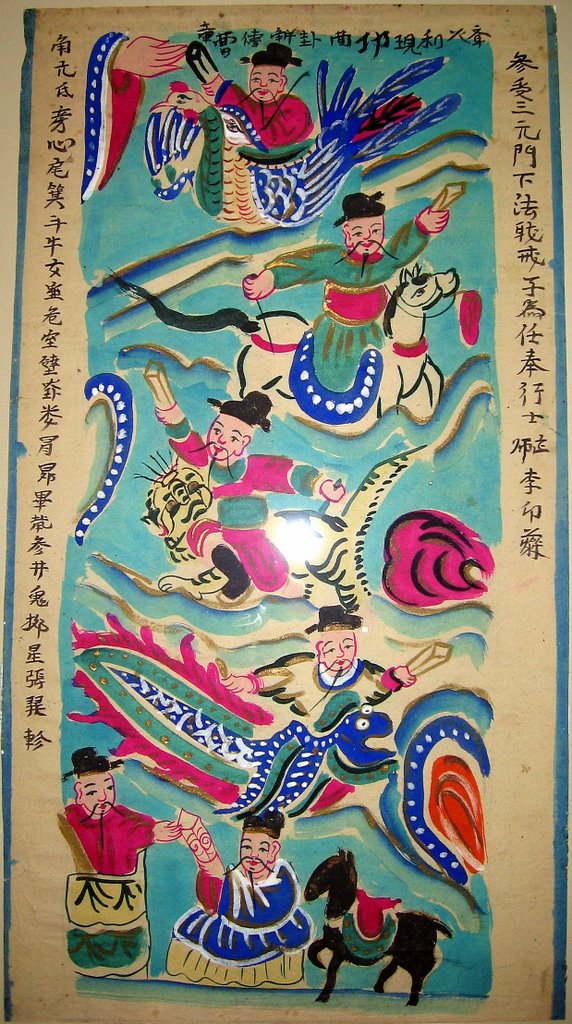
Painting #1 (click to see it) depicts the Four Messengers (or Liaison Officers) of the Governors of the four supernatural realms. The messenger for the Governor of the Sky rides the white crane at the top. The messenger for the Governor of This World comes next on the white horse. Below him is the messenger for the Governor of the Underworld on a tiger (which were thought to dig up corpses and graves). Finally we have the messenger of the Governor of the Waters at the bottom riding a dragon.
It seems these messengers have a role not unlike Hermes, shuttling back and forth between the high priests, one of whom you can see at the bottom left, and the gods. At the top left corner is the hand of a supreme deity who is receiving the messages. I still don't know who this is. The Jade Emporer?
There is a painting reproduced in J. Pourret's book "The Yao" (p. 241) with exactly the same figures in exactly the same configuration.
Wulingren was able to interpret some of the text at the margins (from the comments):
The painting seems to be a representation of what takes place on a heavenly level during an ordination ritual, and is probably hung during the ritual. In the bottom you see the teacher, in this case, surnamed Li, and the student, with tablet.... On the right side, it says, "receive the disciples of the sanyuan (translated as 3 primals, 3 origins, 3 principles--the upper primal/heaven, the middle primal/earth, and the lower primal/water).It is still unclear what the relationship is between the 3 primals and the messengers of the four supernatural realms depicted.
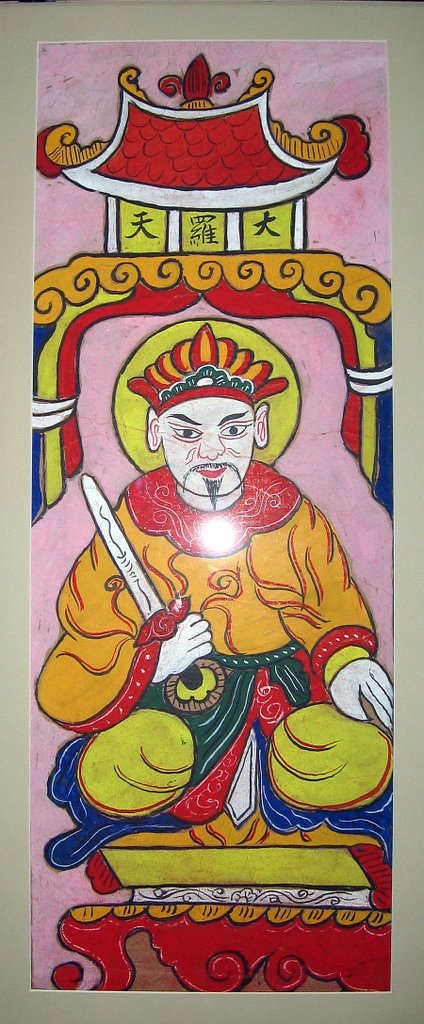
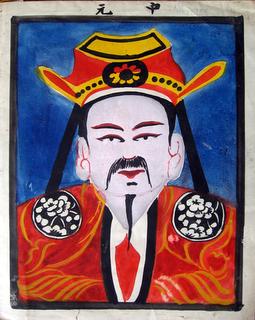 Painting #2 (click to see it): I know much less about this one except that Anonymous tells me the Chinese characters at the top read "Dai Lua" which is the Taoist heaven. But who is this guy in the picture? I could find no clues in the books I've consulted on Yao paintings. Possibly he is one of the guardians of the temple? Looks like he's keeping someone at bay.
As it happens I picked up these two small folksy portraits at the same store in Hanoi. I thought very little about them and in fact mostly forgot them until i came across a section in Pourret's book on Mun Yao paper masks. I had a flash of recognition. These masks are worn by Mun Yao priests "on his forehead whenever he needs to impersonate a particular deity for the ritual at hand". Just a hunch.
 By the way, the store where I bought this stuff had piles of these Yao paintings which were going for reasonable prices (though I had a Vietnamese friend with me to help me drive a hard bargain). I picked my scrolls because of their excellent condition and bright colours, but I remember seeing many very old looking ones in more muted mulberry colours (probably more historic). There has got to be some important stuff there, though many are falling apart. So, if you happen to be in Hanoi, the store is just south of the little corner of Ngo To Tich and Hang Quat in the Old Quarter (maybe 1 or 2 doors down on the east side of the street). The paintings are upstairs. While you're at it, get a trai cay dam further down the street!
posted by HanoiMark at 12:13 PM
|
4 comments